Reliable Workday-Pro-Integrations Test Practice | Real Workday-Pro-Integrations Braindumps
Wiki Article
2026 Latest Actual4Exams Workday-Pro-Integrations PDF Dumps and Workday-Pro-Integrations Exam Engine Free Share: https://drive.google.com/open?id=1s2JqgAopONvNC23nNG6x7nWh1sMk-G9T
To learn more about our Workday-Pro-Integrations exam braindumps, feel free to check our Workday Exam and Certifications pages. You can browse through our Workday-Pro-Integrations certification test preparation materials that introduce real exam scenarios to build your confidence further. Choose from an extensive collection of products that suits every Workday-Pro-Integrations Certification aspirant. You can also see for yourself how effective our methods are, by trying our free demo. So why choose other products that can’t assure your success? With Actual4Exams, you are guaranteed to pass Workday-Pro-Integrations certification on your very first try.
Workday Workday-Pro-Integrations Exam Syllabus Topics:
| Topic | Details |
|---|---|
| Topic 1 |
|
| Topic 2 |
|
| Topic 3 |
|
| Topic 4 |
|
>> Reliable Workday-Pro-Integrations Test Practice <<
Real Workday-Pro-Integrations Braindumps | Reliable Workday-Pro-Integrations Test Forum
our Workday-Pro-Integrations study materials will also save your time and energy in well-targeted learning as we are going to make everything done in order that you can stay focused in learning our Workday-Pro-Integrations study materials without worries behind. We are so honored and pleased to be able to read our detailed introduction and we will try our best to enable you a better understanding of our Workday-Pro-Integrations Study Materials better.
Workday Pro Integrations Certification Exam Sample Questions (Q31-Q36):
NEW QUESTION # 31
You have been asked to create an integration using the Core Connector: Worker with DIS template. The vendor has requested that you only include employees who are based in the San Francisco area that are on leave.
How do you configure your integration so that only workers who meet the requirements are included in the output file?
- A. Configure a Boolean field for Population Eligibility for San Francisco workers on leave.
- B. Configure a Boolean field for San Francisco workers on leave in the field overrides.
- C. Configure the integration attributes to include workers in San Francisco on leave.
- D. Configure a Boolean field for San Francisco workers on leave under the field attributes.
Answer: A
Explanation:
When using Core Connector: Worker with DIS, to restrict the population to employees who:
* Are on leave, and
* Are located in San Francisco
You must configure Population Eligibility, which is the only place to filter the worker population included in the connector output.
From Workday Pro documentation:
"The Population Eligibility section defines which workers are eligible for extraction in the integration based on location, status, organization, and other conditions. Boolean calculated fields can be used here to define complex eligibility criteria." In this case:
* Create a Boolean calculated field that returns true for "On Leave AND Location = San Francisco"
* Use that field in Population Eligibility
Why the others are incorrect:
* A, D. Field Overrides and Field Attributes only modify what data is extracted-not who is included.
* C. Integration Attributes don't control population filtering.
Reference:Workday Pro: Core Connector Worker - Population Eligibility and Filtering LogicWorkday Community - Using Boolean Fields in Population Eligibility Rules
NEW QUESTION # 32
Refer to the following XML to answer the question below.
Refer to the following XML to answer the question below.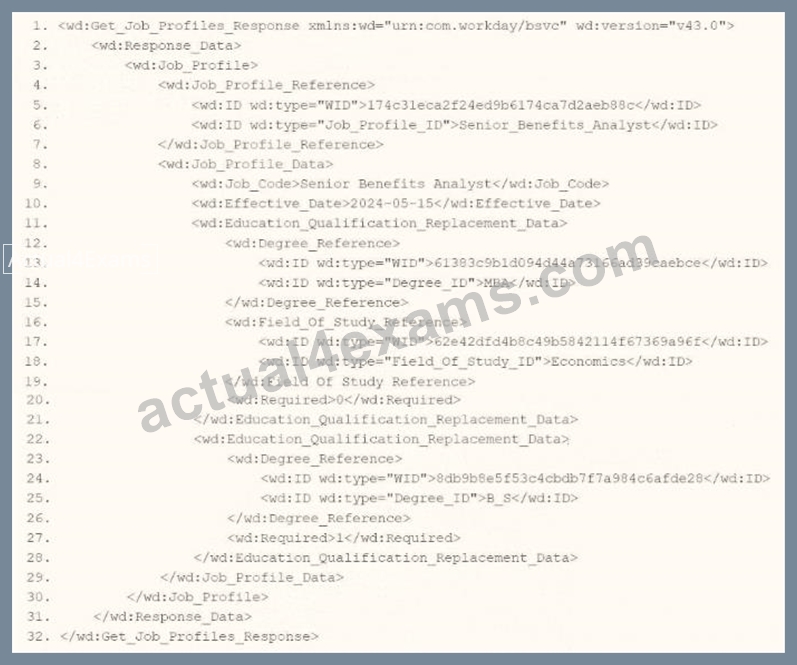
You are an integration developer and need to write XSLT to transform the output of an EIB which is making a request to the Get Job Profiles web service operation. The root template of your XSLT matches on the <wd:Get_Job_Profiles_Response> element. This root template then applies templates against <wd:Job_Profile>. XPath contains a number of delivered functions such as format-date. The format-date function uses the following syntax: format-date ($value as xs: date? $picture as xs:string). Within the template which matches on <wd:Job_Profile>, what XPath syntax would you use to output the value of the <wd:Effective_Date> element formatted with the day-month-year format of "15-07-2024"?
- A. format-date('[M01]-[D01]-[Y0001]', wd:Job_Profile_Data/wd:Effective_Date)
- B. format-date (wd:Job_Profile_Data/wd:Effective_Date, '[M01]-[D01]-[Y0001]')
- C. format-date('[D01]-[M01]-[Y0001]', wd:Job_Profile_Data/wd:Effective_Date)
- D. format-date (wd:Job_Profile_Data/wd:Effective_Date, '[D01]-[M01]-[Y0001]')
Answer: D
Explanation:
As an integration developer working with Workday, you are tasked with transforming the output of an Enterprise Interface Builder (EIB) that calls the Get_Job_Profiles web service operation. The XML provided shows the response from this operation, and you need to write XSLT to format the <wd:Effective_Date> element within the <wd:Job_Profile_Data> section. Specifically, you need to output the date "2024-05-15" (as seen in the XML) in the format "15-07-2024" (day-month-year). The root template of your XSLT matches on <wd:Get_Job_Profiles_Response> and applies templates to <wd:Job_Profile>. You are using the format-date XPath function, which follows the syntax: format-date($value as xs:date?, $picture as xs:string). Let's analyze the XML, the requirement, and each option to determine the correct XPath syntax.
Understanding the XML and Requirement
The provided XML snippet shows a response from the Get_Job_Profiles web service operation in Workday, formatted in SOAP XML with the Workday namespace (xmlns:wd="urn:com.workday/bsvc"). Key elements relevant to the question include:
The root element is <wd:Get_Job_Profiles_Response>.
It contains <wd:Response_Data>, which includes <wd:Job_Profile> elements.
Within <wd:Job_Profile>, there is <wd:Job_Profile_Data>, which contains <wd:Effective_Date> with the value 2024-05-15.
You need to transform this date into the format "15-07-2024" (DD-MM-YYYY), where:
"15" is the day (D01 for two digits).
"07" is the month (M01 for two digits, noting the XML shows May, but the question specifies July for the output format-likely a hypothetical or test case adjustment).
"2024" is the year (Y0001 for four digits).
The format-date function in XPath 2.0 (used by Workday) formats a date value according to a picture string. The syntax is:
First parameter: The date value (e.g., wd:Job_Profile_Data/wd:Effective_Date), which must be an xs:date or convertible to one.
Second parameter: The picture string (e.g., '[D01]-[M01]-[Y0001]'), specifying the format using patterns like:
[D01] for two-digit day (01-31).
[M01] for two-digit month (01-12).
[Y0001] for four-digit year (e.g., 2024).
The question specifies that the root template matches <wd:Get_Job_Profiles_Response> and applies templates to <wd:Job_Profile>, so the XPath must navigate to <wd:Job_Profile_Data/wd:Effective_Date> within that context.
Analysis of Options
Let's evaluate each option based on the format-date syntax, the XML structure, and the required output format "15-07-2024":
Option A: format-date('[D01]-[M01]-[Y0001]', wd:Job_Profile_Data/wd:Effective_Date) This option places the picture string ('[D01]-[M01]-[Y0001]') as the first parameter and the date value (wd:Job_Profile_Data/wd:Effective_Date) as the second. However, the format-date function requires the date value as the first parameter and the picture string as the second, per the syntax format-date($value, $picture). Reversing the parameters is incorrect and will result in an error or unexpected output, as format-date expects an xs:date? first. Thus, this option is invalid.
Option B: format-date (wd:Job_Profile_Data/wd:Effective_Date, '[D01]-[M01]-[Y0001]') This option correctly follows the format-date syntax:
First parameter: wd:Job_Profile_Data/wd:Effective_Date, which points to the <wd:Effective_Date> element in the XML (e.g., 2024-05-15). This is an xs:date value, as Workday web services typically return dates in ISO format (YYYY-MM-DD), which format-date can process.
Second parameter: '[D01]-[M01]-[Y0001]', which specifies the output format:
[D01] outputs the day as two digits (e.g., "15").
[M01] outputs the month as two digits (e.g., "05" for May, but the question requests "07" for July-assuming a test case adjustment or hypothetical transformation).
[Y0001] outputs the year as four digits (e.g., "2024").
The XPath wd:Job_Profile_Data/wd:Effective_Date is correctly nested under the <wd:Job_Profile> context, as the template matches on <wd:Job_Profile>. This would transform "2024-05-15" into "15-05-2024" (or "15-07-2024" if the month is adjusted in the logic), matching the required day-month-year format. This option is valid and correct.
Option C: format-date (wd:Job_Profile_Data/wd:Effective_Date, '[M01]-[D01]-[Y0001]') This option also follows the correct format-date syntax, with the date value first and the picture string second. However, the picture string '[M01]-[D01]-[Y0001]' specifies a month-day-year format:
[M01] outputs the month first (e.g., "05" for May).
[D01] outputs the day second (e.g., "15").
[Y0001] outputs the year last (e.g., "2024").
This would transform "2024-05-15" into "05-15-2024," which does not match the required "15-07-2024" (day-month-year) format. Thus, this option is incorrect for the specified output.
Option D: format-date('[M01]-[D01]-[Y0001]', wd:Job_Profile_Data/wd:Effective_Date) Similar to Option A, this option reverses the parameters, placing the picture string ('[M01]-[D01]-[Y0001]') first and the date value (wd:Job_Profile_Data/wd:Effective_Date) second. As explained earlier, format-date requires the date value as the first parameter, so this syntax is incorrect and will not work as intended. This option is invalid.
Why Option B is Correct
Option B correctly uses the format-date function with the proper syntax:
It places the date value (wd:Job_Profile_Data/wd:Effective_Date) as the first parameter, referencing the <wd:Effective_Date> element in the XML.
It uses the picture string '[D01]-[M01]-[Y0001]' as the second parameter, which formats the date as "DD-MM-YYYY" (e.g., "15-05-2024" for the XML's "2024-05-15," or "15-07-2024" as specified, assuming a month adjustment in the transformation logic).
The XPath is appropriate for the context, as the template matches <wd:Job_Profile>, and <wd:Job_Profile_Data/wd:Effective_Date> is a valid path within it.
The question's mention of "15-07-2024" suggests either a hypothetical adjustment (e.g., the EIB or XSLT logic modifies the month to July) or a test case variation. Since the XML shows "2024-05-15," the format-date function would output "15-05-2024" with the given picture string, but the principle of formatting day-month-year remains correct. Workday's XSLT implementation supports such transformations, and the format-date function is well-documented for this purpose.
Practical Example in XSLT
Here's how this might look in your XSLT:
<xsl:template match="wd:Job_Profile">
<xsl:value-of select="format-date(wd:Job_Profile_Data/wd:Effective_Date, '[D01]-[M01]-[Y0001]')"/>
</xsl:template>
This would process the <wd:Effective_Date> (e.g., "2024-05-15") and output "15-05-2024," aligning with the day-month-year format requested (adjusted for the hypothetical "07" if needed elsewhere in the logic).
Verification with Workday Documentation
The Workday Pro Integrations Study Guide and SOAP API Reference (available via Workday Community) detail the use of XPath functions like format-date for transforming web service responses. The Get_Job_Profiles operation returns job profile data, including effective dates, in ISO format, and XSLT transformations are commonly used in EIBs to reformat data. The format-date function's syntax and picture string patterns (e.g., [D01], [M01], [Y0001]) are standard in XPath 2.0, as implemented in Workday's integration tools.
Workday Pro Integrations Study Guide Reference
Section: XSLT Transformations in EIBs - Describes using XSLT to transform web service responses, including date formatting with format-date.
Section: Workday Web Services - Details the Get_Job_Profiles operation and its XML output structure, including <wd:Effective_Date>.
Section: XPath Functions - Explains the syntax and usage of format-date($value, $picture), including picture string patterns like [D01], [M01], and [Y0001].
Workday Community SOAP API Reference - Provides examples of date formatting in XSLT for Workday web services.
Option B is the verified answer, as it correctly applies the format-date function to format the <wd:Effective_Date> in the required day-month-year format.
NEW QUESTION # 33
You have been asked to refine a report which outputs one row per worker and is being used in an integration that sends worker data to one of your third-party systems. The integration should only send workers who have been hired in the last 30 days. Where in the custom report definition can you specify a condition that would include only workers who have been hired in the last 30 days?
- A. Columns
- B. Filter
- C. Subfilter
- D. Output
Answer: B
Explanation:
In Workday, when refining a custom report to include specific conditions such as limiting the output to workers hired in the last 30 days, the appropriate place to specify this condition is within theFiltertab of the custom report definition. The Filter tab allows you to define criteria that determine which instances of the primary business object (in this case, "Worker") are included in the report output. This is critical for integrations, as the filtered data ensures that only relevant records are sent to the third-party system.
The requirement here is to restrict the report to workers hired within the last 30 days. In Workday reporting, this can be achieved by adding a filter condition on the "Hire Date" field of the Worker business object.
Specifically, you would configure the filter to compare the "Hire Date" against a dynamic date range, such as
"Current Date minus 30 days" to "Current Date." This ensures the report dynamically adjusts to include only workers hired in the last 30 days each time it runs, which aligns with the needs of an integration sending real- time data to a third-party system.
Here's why the other options are incorrect:
* A. Subfilter: Subfilters in Workday are used to further refine data within a related business object or a subset of data already filtered by the primary filter. They are not the primary mechanism for applying a condition to the main dataset (e.g., all workers). For this scenario, asubfilter would be unnecessary since the condition applies directly to the Worker business object, not a related object.
* B. Output: The Output section of a custom report definition controls how the report is displayed or delivered (e.g., file format, scheduling), not the data selection criteria. It does not allow for specifying conditions like hire date ranges.
* C. Columns: The Columns tab defines which fields are displayed in the report output (e.g., Worker ID, Name, Hire Date). While you can add the "Hire Date" field here for visibility, it does not control which workers are included in the report-that is the role of the Filter tab.
To implement this in practice:
* In the custom report definition, go to theFiltertab.
* Add a new filter condition.
* Select the "Hire Date" field from the Worker business object.
* Set the operator to "in the range" and define the range as "Current Date - 30 days" to "Current Date" (using dynamic date functions available in Workday).
* Save and test the report to ensure it returns only workers hired within the last 30 days.
This filtered report can then be enabled as a web service (via the Advanced tab) or used in an Enterprise Interface Builder (EIB) or Workday Studio integration to send the data to the third-party system, meeting the integration requirement.
References from Workday Pro Integrations Study Guide:
* Workday Report Writer Fundamentals: Section on "Creating and Managing Filters" explains how filters are used to limit report data based on specific conditions, such as date ranges.
* Integration System Fundamentals: Discusses how custom reports serve as data sources for integrations and the importance of filters in defining the dataset.
* Core Connectors & Document Transformation: Highlights the use of filtered custom reports in outbound integrations to third-party systems.
NEW QUESTION # 34
Refer to the following XML to answer the question below.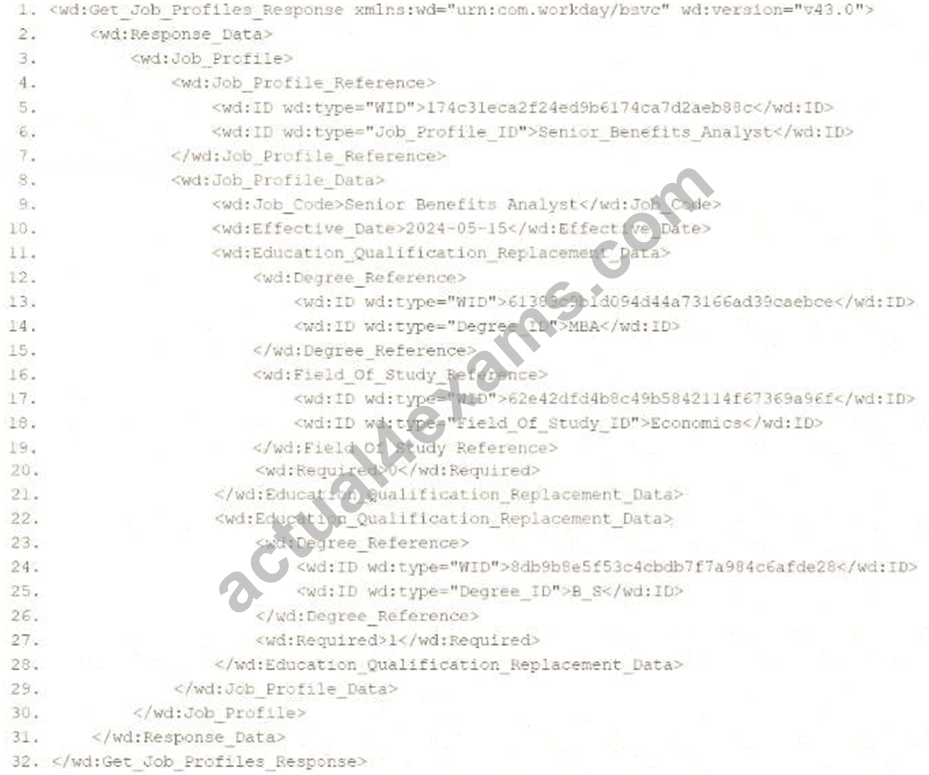
You are an integration developer and need to write XSLT to transform the output of an EIB which is making a request to the Get Job Profiles web service operation. The root template of your XSLT matches on the <wd:
Get_Job_Profiles_Response> element. This root template then applies a template against <wd:Job_Profile>.
What XPath syntax would be used to select the value of the wd:Job_Code element when the <xsl:value-of> element is placed within the template which matches on <wd:Job_Profile>?
- A. wd:Job_Profile_Data[@wd:Job_Code]
- B. wd:Job_Profile_Reference/wd:ID[@wd:type='Job_Profile_ID']
- C. wd:Job_Profile_Data/wd:Job_Code
- D. wd:Job_Profile/wd:Job_Profile_Data/wd:Job_Code
Answer: C
Explanation:
As an integration developer working with Workday, you are tasked with transforming the output of an Enterprise Interface Builder (EIB) that calls the Get_Job_Profiles web service operation. The provided XML shows the response from this operation, and you need to write XSLT to select the value of the <wd:
Job_Code> element. The root template of your XSLT matches on <wd:Get_Job_Profiles_Response> and applies a template to <wd:Job_Profile>. Within this template, you use the <xsl:value-of> element to extract the <wd:Job_Code> value. Let's analyze the XML structure, the requirement, and each option to determine the correct XPath syntax.
Understanding the XML and Requirement
The XML snippet provided is a SOAP response from the Get_Job_Profiles web service operation in Workday, using the namespace xmlns:wd="urn:com.workday/bsvc" and version wd:version="v43.0". Key elements relevant to the question include:
* The root element is <wd:Get_Job_Profiles_Response>.
* It contains <wd:Response_Data>, which includes <wd:Job_Profile> elements.
* Within <wd:Job_Profile>, there are:
* <wd:Job_Profile_Reference>, which contains <wd:ID> elements (e.g., a Job_Profile_ID).
* <wd:Job_Profile_Data>, which contains <wd:Job_Code> with the value
Senior_Benefits_Analyst.
The task is to select the value of <wd:Job_Code> (e.g., "Senior_Benefits_Analyst") using XPath within an XSLT template that matches <wd:Job_Profile>. The <xsl:value-of> element outputs the value of the selected node, so you need the correct XPath path from the <wd:Job_Profile> context to <wd:Job_Code>.
Analysis of Options
Let's evaluate each option based on the XML structure and XPath syntax rules:
* Option A: wd:Job_Profile/wd:Job_Profile_Data/wd:Job_Code
* This XPath starts from wd:Job_Profile and navigates to wd:Job_Profile_Data/wd:Job_Code.
However, in the XML, <wd:Job_Profile> is the parent element, and <wd:Job_Profile_Data> is a direct child containing <wd:Job_Code>. The path wd:Job_Profile/wd:Job_Profile_Data/wd:
Job_Code is technically correct in terms of structure, as it follows the hierarchy:
* <wd:Job_Profile> # <wd:Job_Profile_Data> # <wd:Job_Code>.
* However, since the template matches <wd:Job_Profile>, the context node is already <wd:
Job_Profile>. You don't need to include wd:Job_Profile/ at the beginning of the XPath unless navigating from a higher level. Starting directly with wd:Job_Profile_Data/wd:Job_Code (Option C) is more concise and appropriate for the context. This option is technically valid but redundant and less efficient, making it less preferred compared to Option C.
* Option B: wd:Job_Profile_Data[@wd:Job_Code]
* This XPath uses an attribute selector ([@wd:Job_Code]) to filter <wd:Job_Profile_Data> based on an attribute named wd:Job_Code. However, examining the XML, <wd:Job_Profile_Data> does not have a wd:Job_Code attribute-it has a child element <wd:Job_Code> with the value
"Senior_Benefits_Analyst." The [@attribute] syntax is used for attributes, not child elements, so this XPath is incorrect. It would not select the <wd:Job_Code> value and would likely return no results or an error. This option is invalid.
* Option C: wd:Job_Profile_Data/wd:Job_Code
* This XPath starts from wd:Job_Profile_Data (a direct child of <wd:Job_Profile>) and navigates to wd:Job_Code. Since the template matches <wd:Job_Profile>, the context node is <wd:
Job_Profile>, and wd:Job_Profile_Data/wd:Job_Code correctly points to the <wd:Job_Code> element within <wd:Job_Profile_Data>. This path is:
* Concise and appropriate for the context.
* Directly selects the value "Senior_Benefits_Analyst" when used with <xsl:value-of>.
* Matches the XML structure, as <wd:Job_Profile_Data> contains <wd:Job_Code> as a child.
* This is the most straightforward and correct option for selecting the <wd:Job_Code> value within the <wd:Job_Profile> template.
* Option D: wd:Job_Profile_Reference/wd:ID[@wd:type='Job_Profile_ID']
* This XPath navigates to <wd:Job_Profile_Reference> (a child of <wd:Job_Profile>) and then to
<wd:ID> with an attribute wd:type="Job_Profile_ID". In the XML, <wd:Job_Profile_Reference> contains:
* <wd:ID wd:type="WID">1740d3eca2f2ed9b6174ca7d2ae88c8c</wd:ID>
* <wd:ID wd:type="Job_Profile_ID">Senior_Benefits_Analyst</wd:ID>
* The XPath wd:Job_Profile_Reference/wd:ID[@wd:type='Job_Profile_ID'] selects the <wd:ID> element with wd:type="Job_Profile_ID", which has the value "Senior_Benefits_Analyst." However, this is not the <wd:Job_Code> value-the <wd:Job_Code> is a separate element under
<wd:Job_Profile_Data>, not <wd:Job_Profile_Reference>. The question specifically asks for the
<wd:Job_Code> value, so this option is incorrect, as it selects a different piece of data (the job profile ID, not the job code).
Why Option C is Correct
Option C, wd:Job_Profile_Data/wd:Job_Code, is the correct XPath syntax because:
* It starts from the context node <wd:Job_Profile> (as the template matches this element) and navigates to <wd:Job_Profile_Data/wd:Job_Code>, which directly selects the <wd:Job_Code> element's value ("Senior_Benefits_Analyst").
* It is concise and aligns with standard XPath navigation in XSLT, avoiding unnecessary redundancy (unlike Option A) or incorrect attribute selectors (unlike Option B).
* It matches the XML structure, where <wd:Job_Profile_Data> is a child of <wd:Job_Profile> and contains <wd:Job_Code> as a child.
* When used with <xsl:value-of select="wd:Job_Profile_Data/wd:Job_Code"/> in the template, it outputs the job code value, fulfilling the requirement.
Practical Example in XSLT
Here's how this might look in your XSLT:
xml
WrapCopy
<xsl:template match="wd:Job_Profile">
<xsl:value-of select="wd:Job_Profile_Data/wd:Job_Code"/>
</xsl:template>
This would output "Senior_Benefits_Analyst" for the <wd:Job_Code> element in the XML.
Verification with Workday Documentation
The Workday Pro Integrations Study Guide and SOAP API Reference (available via Workday Community) detail the structure of the Get_Job_Profiles response and how to use XPath in XSLT for transformations. The XML structure shows <wd:Job_Profile_Data> as the container for job profile details, including <wd:
Job_Code>. The guide emphasizes using relative XPath paths within templates to navigate from the matched element (e.g., <wd:Job_Profile>) to child elements like <wd:Job_Profile_Data/wd:Job_Code>.
Workday Pro Integrations Study Guide References
* Section: XSLT Transformations in EIBs - Describes using XSLT to transform web service responses, including selecting elements with XPath.
* Section: Workday Web Services - Details the Get_Job_Profiles operation and its XML output structure, including <wd:Job_Profile_Data> and <wd:Job_Code>.
* Section: XPath Syntax - Explains how to navigate XML hierarchies in Workday XSLT, using relative paths like wd:Job_Profile_Data/wd:Job_Code from a <wd:Job_Profile> context.
* Workday Community SOAP API Reference - Provides examples of XPath navigation for Workday web service responses.
Option C is the verified answer, as it correctly selects the <wd:Job_Code> value using the appropriate XPath syntax within the <wd:Job_Profile> template context.
NEW QUESTION # 35
Refer to the following XML data source to answer the question below.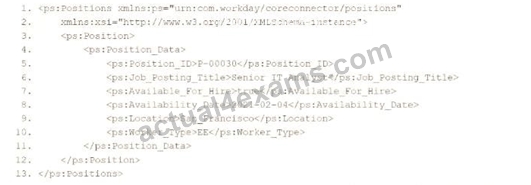
You need the integration file to format the ps:Position_ID field to 10 characters, truncate the value if it exceeds, and align everything to the left.
How will you start your template match on ps:Position to use Document Transformation (DT) to do the transformation using XTT?
- A.

- B.

- C.

- D.
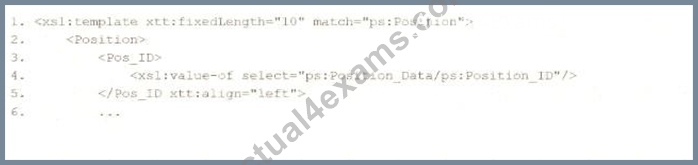
Answer: A
Explanation:
In Workday integrations, Document Transformation (DT) using XSLT with Workday Transformation Toolkit (XTT) attributes is used to transform XML data, such as the output from a Core Connector or EIB, into a specific format for third-party systems. In this scenario, you need to transform the ps:Position_ID field within the ps:Position element to a fixed length of 10 characters, truncate the value if it exceeds 10 characters, and align the output to the left. The template must match the ps:Position element and apply these formatting rules using XTT attributes.
Here's why option A is correct:
* Template Matching: The <xsl:template match="ps:Position"> correctly targets the ps:Position element in the XML, as shown in the provided snippet, ensuring the transformation applies to the appropriate node.
* XTT Attributes:
* xtt:fixedLength="10" specifies that the Pos_ID field should be formatted to a fixed length of 10 characters. If the ps:Position_ID value exceeds 10 characters, it will be truncated (by default, XTT truncates without raising an error unless explicitly configured otherwise), meeting the requirement to truncate if the value exceeds.
* xtt:align="left" ensures that the output is left-aligned within the 10-character field, aligning with the requirement to align everything to the left.
* XPath Selection: The <xsl:value-of select="ps:Position_Data/ps:Position_ID"/> correctly extracts the ps:Position_ID value (e.g., "P-00030") from the ps:Position_Data child element, as shown in the XML structure.
* Output Structure: The <Position><Pos_ID>...</Pos_ID></Position> structure ensures the transformed data is wrapped in meaningful tags for the target system, maintaining consistency with Workday integration practices.
Why not the other options?
* B.
xml
WrapCopy
<xsl:template xtt:align="left" match="ps:Position">
<Position>
<Pos_ID xtt:fixedLength="10">
<xsl:value-of select="ps:Position_Data/ps:Position_ID"/>
</Pos_ID>
</Position>
</xsl:template>
This applies xtt:align="left" to the xsl:template element instead of the Pos_ID element. XTT attributes like fixedLength and align must be applied directly to the element being formatted (Pos_ID), not the template itself, making this incorrect.
* C.
xml
WrapCopy
<xsl:template match="ps:Position">
<Position xtt:fixedLength="10">
<Pos_ID xtt:align="left">
<xsl:value-of select="ps:Position_Data/ps:Position_ID"/>
</Pos_ID>
</Position>
</xsl:template>
This applies xtt:fixedLength="10" to the Position element and xtt:align="left" to Pos_ID. However, XTT attributes like fixedLength and align should be applied to the specific field being formatted (Pos_ID), not the parent element (Position). This misplacement makes it incorrect.
* D.
xml
WrapCopy
<xsl:template xtt:fixedLength="10" match="ps:Position">
<Position>
<Pos_ID xtt:align="left">
<xsl:value-of select="ps:Position_Data/ps:Position_ID"/>
</Pos_ID>
</Position>
</xsl:template>
This applies xtt:fixedLength="10" to the xsl:template element and xtt:align="left" to Pos_ID. Similar to option B, XTT attributes must be applied to the specific element (Pos_ID) being formatted, not the template itself, making this incorrect.
To implement this in XSLT for a Workday integration:
* Use the template from option A to match ps:Position, apply xtt:fixedLength="10" and xtt:align="left" to the Pos_ID element, and extract the ps:Position_ID value using the correct XPath. This ensures the ps:
Position_ID (e.g., "P-00030") is formatted to 10 characters, truncated if necessary, and left-aligned, meeting the integration file requirements.
Workday Pro Integrations Study Guide: Section on "Document Transformation (DT) and XTT" - Details the use of XTT attributes like fixedLength and align for formatting data in XSLT transformations, including truncation behavior.
Workday Core Connector and EIB Guide: Chapter on "XML Transformations" - Explains how to use XSLT templates with XTT attributes to transform position data, including fixed-length formatting and alignment.
Workday Integration System Fundamentals: Section on "XTT in Integrations" - Covers the application of XTT attributes to specific fields in XML for integration outputs, ensuring compliance with formatting requirements like length and alignment.
NEW QUESTION # 36
......
We provide up-to-date Workday Pro Integrations Certification Exam (Workday-Pro-Integrations) exam questions and study materials in three different formats. We have developed three variations of authentic Workday Workday-Pro-Integrations exam questions to cater to different learning preferences, ensuring that all candidates can effectively prepare for the Workday-Pro-Integrations Practice Test. Actual4Exams offers Workday Pro Integrations Certification Exam (Workday-Pro-Integrations) practice questions in PDF format, browser-based practice exams, and desktop practice test software.
Real Workday-Pro-Integrations Braindumps: https://www.actual4exams.com/Workday-Pro-Integrations-valid-dump.html
- Exam Workday-Pro-Integrations Bootcamp ???? Valid Braindumps Workday-Pro-Integrations Questions ???? Workday-Pro-Integrations Valid Exam Sims ???? Easily obtain free download of 《 Workday-Pro-Integrations 》 by searching on ➥ www.testkingpass.com ???? ????Valid Workday-Pro-Integrations Exam Cost
- Authentic Workday-Pro-Integrations Exam Hub ???? Workday-Pro-Integrations Test Sample Questions ???? Study Workday-Pro-Integrations Plan ???? Easily obtain ⇛ Workday-Pro-Integrations ⇚ for free download through { www.pdfvce.com } ????Authentic Workday-Pro-Integrations Exam Hub
- Certification Workday-Pro-Integrations Dump ???? Workday-Pro-Integrations Valid Exam Online ???? Workday-Pro-Integrations Reliable Test Cram ???? Search for 「 Workday-Pro-Integrations 」 and easily obtain a free download on ⇛ www.prepawayexam.com ⇚ ????Workday-Pro-Integrations Exam Discount Voucher
- Study Workday-Pro-Integrations Plan ???? Flexible Workday-Pro-Integrations Testing Engine ???? Reliable Workday-Pro-Integrations Exam Question ???? Go to website ✔ www.pdfvce.com ️✔️ open and search for ➡ Workday-Pro-Integrations ️⬅️ to download for free ????Valid Braindumps Workday-Pro-Integrations Questions
- Workday-Pro-Integrations Latest Test Pdf ???? Valid Workday-Pro-Integrations Exam Cost ???? Exam Workday-Pro-Integrations Consultant ???? Easily obtain 【 Workday-Pro-Integrations 】 for free download through 【 www.examcollectionpass.com 】 ????Workday-Pro-Integrations Valid Exam Online
- Valid Dumps Workday-Pro-Integrations Free ⏪ Workday-Pro-Integrations Valid Exam Online ???? Workday-Pro-Integrations Reliable Test Cram ???? Copy URL ▛ www.pdfvce.com ▟ open and search for [ Workday-Pro-Integrations ] to download for free ⚠Premium Workday-Pro-Integrations Files
- 2026 Reliable Workday-Pro-Integrations Test Practice | Latest Real Workday-Pro-Integrations Braindumps: Workday Pro Integrations Certification Exam ???? Go to website 《 www.prep4away.com 》 open and search for ▷ Workday-Pro-Integrations ◁ to download for free ????Valid Braindumps Workday-Pro-Integrations Questions
- Workday-Pro-Integrations - Workday Pro Integrations Certification Exam –Efficient Reliable Test Practice ???? ⇛ www.pdfvce.com ⇚ is best website to obtain 「 Workday-Pro-Integrations 」 for free download ????Workday-Pro-Integrations Test Lab Questions
- Workday-Pro-Integrations Reliable Test Cram ???? Flexible Workday-Pro-Integrations Testing Engine ???? Authentic Workday-Pro-Integrations Exam Hub ⬇ Easily obtain 「 Workday-Pro-Integrations 」 for free download through 《 www.examcollectionpass.com 》 ????Workday-Pro-Integrations Test Lab Questions
- Workday-Pro-Integrations Latest Test Pdf ???? Workday-Pro-Integrations Valid Exam Sims ???? Workday-Pro-Integrations Test Sample Questions ???? Search for 「 Workday-Pro-Integrations 」 and obtain a free download on ➤ www.pdfvce.com ⮘ ????Exam Workday-Pro-Integrations Fees
- Quiz Useful Workday-Pro-Integrations - Reliable Workday Pro Integrations Certification Exam Test Practice ???? Open website [ www.pdfdumps.com ] and search for ➽ Workday-Pro-Integrations ???? for free download ????Reliable Workday-Pro-Integrations Exam Question
- african-academy-agri.com, safakleq066831.daneblogger.com, daninicourse.com, cormacpeyr387717.ourcodeblog.com, fannievegq542454.wikinarration.com, phoenixcdtm157087.vblogetin.com, phoenixuink979730.blogrenanda.com, chiarazdaf252719.blogchaat.com, marvincvaa494661.blogdomago.com, my-social-box.com, Disposable vapes
DOWNLOAD the newest Actual4Exams Workday-Pro-Integrations PDF dumps from Cloud Storage for free: https://drive.google.com/open?id=1s2JqgAopONvNC23nNG6x7nWh1sMk-G9T
Report this wiki page